A practical guide to choosing an industrial inkjet printer: single-pass vs multi-pass, substrate compatibility, print speed and total cost of ownership.
An industrial inkjet printer can run at up to 50-100 metres per minute, with no contact with the substrate and no set-up costs when the artwork changes. The choice between single-pass and multi-pass, and between UV and water-based systems, determines the cost profile and the range of applications.
Single-pass vs multi-pass
Single-pass technology
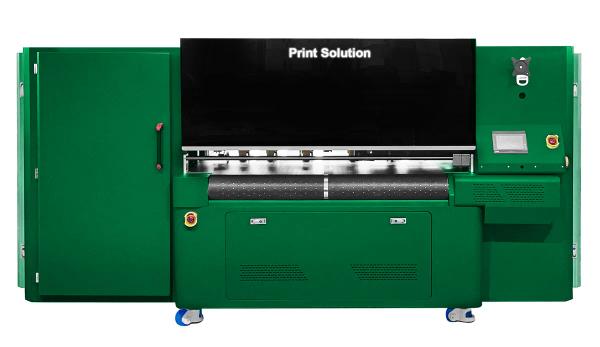
In single-pass printers a bar of printheads covers the whole print width. The substrate passes under the bar only once, which gives very high production speeds (up to 50-100 m/min). This technology is ideal for continuous production and high volumes.
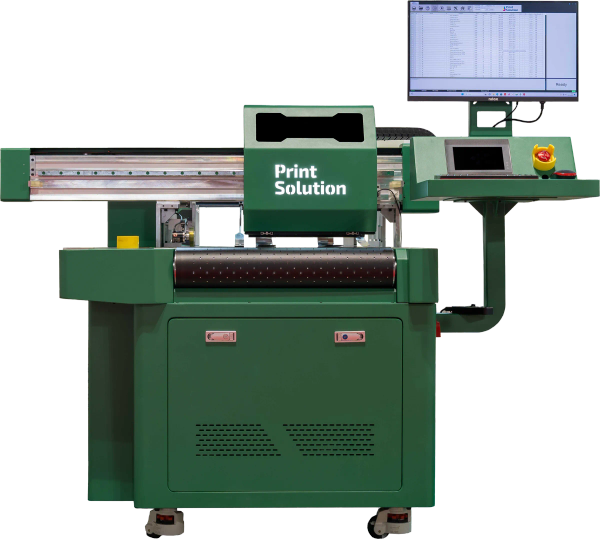
Print Solution's EDM-650X uses single-pass technology with HP PageWide printheads to print directly on corrugated board at up to 1200 × 1200 dpi, with a print width from 60 to 180 cm.

Multi-pass technology
Multi-pass (or scanning) printers move the printhead back and forth over a substrate that is stationary or advancing slowly. They offer very high resolutions (up to 1440 dpi) but limited speed. Ideal for prototypes, samples and very short runs where quality comes first.
Ink types
Water-based inks
Eco-friendly and odourless, they are the preferred choice for packaging and indoor applications. They give vivid colours and penetrate well into porous substrates such as paper and board. They need drying (hot air or IR).
UV inks
They cure instantly under UV light and adhere to almost any surface, including non-porous ones. Excellent resistance to abrasion, water and light. Ideal for outdoor applications and synthetic substrates.
Solvent inks
Highly weather-resistant, suited to large-format outdoor printing. In industrial packaging they are used for marking and coding on non-absorbent surfaces.
Key selection criteria
- Production speed — how many linear metres or sheets per hour do you need?
- Print width — it must cover the largest size of your substrates
- Resolution — 300 dpi for text and barcodes, 600+ dpi for photographic images
- Substrate type — corrugated board, paper, plastic film, metal
- Ink type — depending on the end application and regulations
- Integration — compatibility with existing production lines
- Running costs — ink consumption, printhead maintenance, spare parts
- Technical support — availability of local support and response times
Industrial applications
Printing on corrugated board
The main application of single-pass industrial inkjet printers: boxes, displays, packaging for e-commerce and retail. The EDM-650X is designed specifically for this application, with automatic feeding and board up to 80 mm thick.
Roll label printing
For high label volumes, industrial printers such as the Afinia L901 Plus reach up to 18 m/min with consistent quality, and can work alongside finishing systems for cutting, laminating and rewinding.
Marking and coding
Inkjet systems that print barcodes, expiry dates, batch numbers and QR codes directly on high-speed packaging lines.
The role of technical support
An industrial printer is a significant investment. The quality of after-sales support is essential: response times, spare parts availability, operator training and remote support make the difference between a productive investment and a source of frustration.
Print Solution provides direct technical support throughout Italy, operator training and remote assistance to solve problems quickly.
Conclusion
The right industrial inkjet printer depends on the application, the volume and the substrate. Single-pass for high productivity, multi-pass for maximum quality, water-based inks for paper and board, UV for versatility. What matters is assessing the full total cost of ownership and the quality of technical support.
Related products
For industrial printing on corrugated board, the EDM-650X is the single-pass solution for high-volume production.
For inkjet printing on roll labels, discover the Afinia L901 with high-speed Memjet technology.