When does digital printing beat offset? A cost and quality comparison for short to medium runs, with guidance on which technology fits your production volumes.
For runs below 500-1,000 pieces, digital printing is almost always the right choice: no set-up costs, short lead times and every copy can be personalised. Above that threshold, offset regains the cost advantage as plate costs are spread over more copies.
How the two technologies work
Offset printing
Offset uses metal plates (one per colour) that transfer the ink to a rubber blanket and then to the substrate. It needs a long and costly set-up: plate making, machine make-ready, colour calibration. That is why it only pays off on long runs (typically over 1,000-5,000 copies).
Digital printing

Digital printing transfers the image straight from the file to the substrate, with no intermediate plates. Set-up is practically instant: you send the file and print. This removes fixed costs and makes even a single piece affordable to print.
The break-even point
The key concept is the break-even point: the quantity at which the unit cost of offset falls below that of digital. In label printing it typically lies between 1,000 and 5,000 units. For corrugated packaging it can be even higher.
Below break-even, digital costs less per unit. Above it, offset becomes cheaper because its fixed costs are spread over many copies.
Advantages of digital printing for short runs
- No set-up costs — no plates, no machine make-ready
- Variable data — every print can be different (numbering, QR codes, personalisation)
- Faster time to market — from file to print in minutes, not days
- No minimum order — even a single piece makes economic sense
- Market testing — try new designs with no financial commitment
- Versioning — easily manage language, market or seasonal variants
Digital quality today
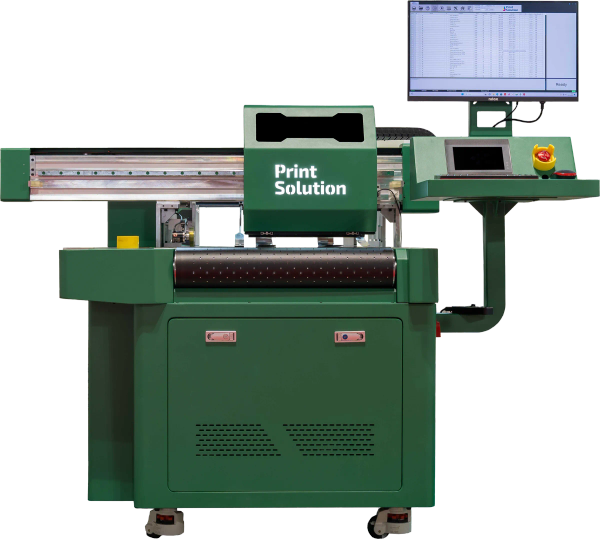
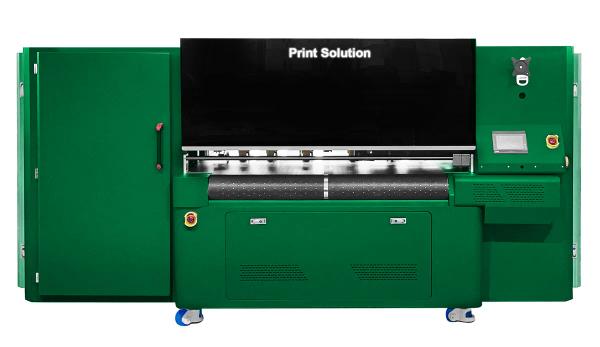
The latest digital printers have closed the quality gap with offset. Systems such as the EDM-650X for corrugated board reach up to 1200 × 1200 dpi with single-pass technology, delivering vivid colours and sharp detail even on rough substrates.
For labels, printers such as the Afinia L901 offer photographic quality at up to 18 m/min, comparable to flexographic systems but without plate and set-up costs.
When to choose offset
Offset is still the best choice for:
- Runs over 5,000-10,000 copies with fixed artwork
- Specific Pantone colours that cannot be reproduced in CMYK
- Very special substrates that need dedicated inks
- Continuous, repetitive production with unchanging artwork
The hybrid approach
Many companies take a hybrid approach: digital printing for short runs, prototypes and personalised variants; offset for mass runs. This optimises costs across the whole production range.
With solutions like those offered by Print Solution, you can bring short-run digital production in-house while keeping offset outsourced for large volumes, getting the best of both worlds.
Conclusion
For short runs, digital printing is now the most rational choice economically, in quality and in logistics. By removing fixed costs, waiting times and minimum orders, it lets companies be more agile and responsive. The question is no longer “digital or offset?” but “which one pays off for this run?”
Related products
For short and medium runs of colour labels, discover the Afinia L901.
For packaging and corrugated boxes, the EDM-650X is the ideal digital solution for variable runs with no set-up costs.