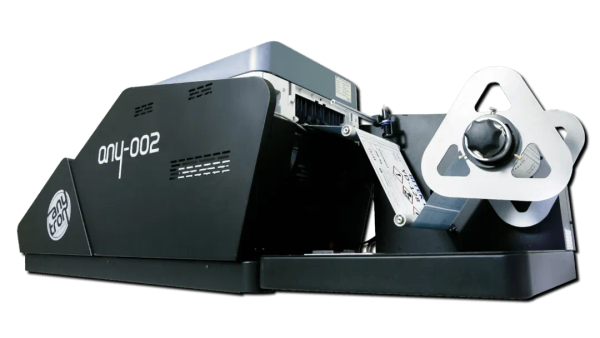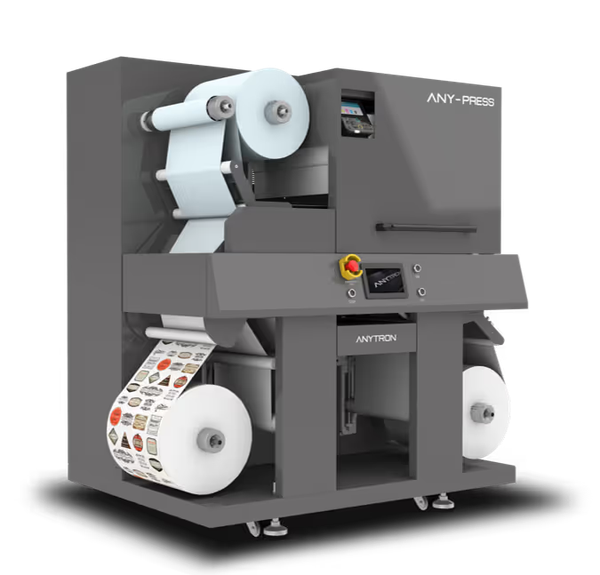
Three to four million eggs a year, dozens of pack formats and customer-specific requirements: how a Swiss producer brought label printing in-house with the Anytron ANY-002, and ended up installing a second one.
Bringing label printing inside the company is not only a technology decision: it is a different way of organising production. The case of Eugster Eier illustrates it well — a Swiss egg producer packing between three and four million pieces a year, which chose the Anytron ANY-002 digital roll label printer to manage all of its labels internally. It is a case history published by Anytron, whose products Print Solution distributes in Italy, and it describes with precision a problem shared by a great many Italian food companies.
The company: many SKUs, one packing line
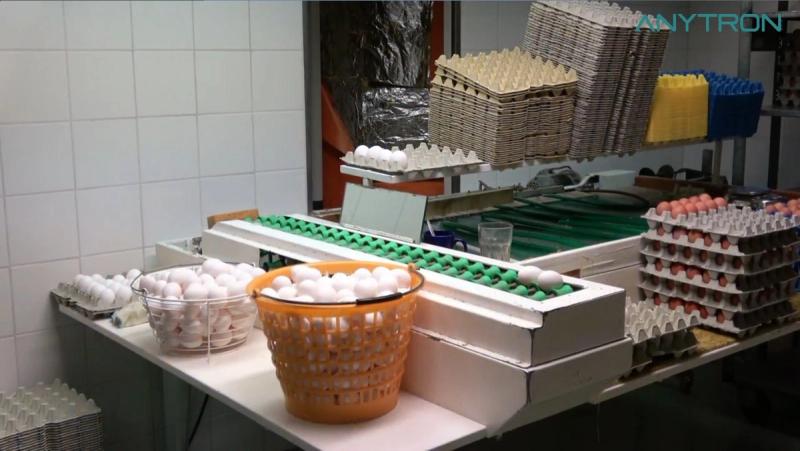
Eugster Eier started as a poultry farm in the 1950s and has grown over time into a business that combines production, processing and packing. Today it produces around 3-4 million eggs a year: some are packed fresh for retail, others are processed into whole egg, yolk, egg white, peeled eggs and hard-boiled eggs.
The critical point is packing. Formats change according to the product and the customer: six-packs, ten-packs, other configurations, right up to packaging prepared to a single customer's specification. Every combination of product, format and weight is, in practice, a different label.
The problem: too many different labels, unpredictable quantities
As the range of SKUs grew, label management became the bottleneck. The picture described in the case history is the classic one:
- Different artwork for every variant of product and pack format.
- Highly variable quantities: some jobs called for only a handful of labels, others for far larger runs.
- Customer-specific requirements, which could change from one order to the next.
Depending entirely on an outside printer made this variability hard to govern: every job had to be scheduled with the supplier, on the supplier's lead times and minimum order quantities, and labels were often printed in excess of what was needed simply to make the cost work — with the very real risk of throwing them away as soon as a single line of wording changed.
The solution: digital roll printing brought in-house
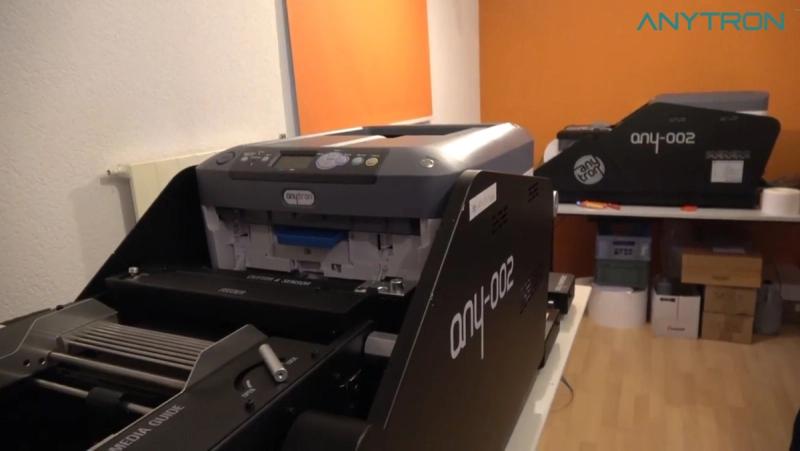
The company chose to internalise printing by installing an Anytron ANY-002, a digital colour printer for roll labels. With the machine on site, labels are prepared to the rhythm of production rather than the supplier's: you print the quantity a given job needs, a few dozen or several thousand, without renegotiating anything externally.
"I can produce individual labels in small or large runs. I'm very flexible — not dependent on any external printer."

That is the key shift: the label stops being an external constraint and goes back to being a variable the company controls, aligned with its own packing schedule.
The application: labels for fresh eggs and processed products
The labels cover the whole range: retail packs varying by egg count and weight class, processed products with different information and formats, customer-specific packaging. A single fixed artwork would never be enough to cover daily production.
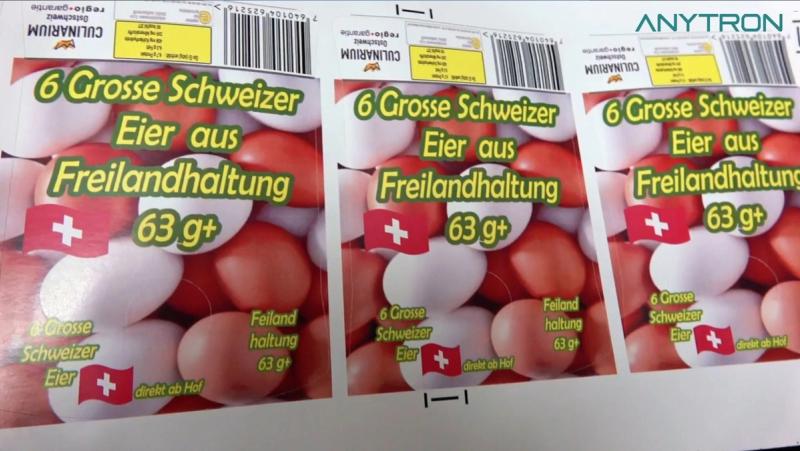
With digital printing all these variants live inside one workflow, and each label is produced in the quantity the batch requires. This is exactly the scenario where digital beats traditional technologies: many SKUs, short runs, frequent changes.
The result: a second machine
After gaining experience with the first ANY-002, the company installed a second unit, to make in-house label production more structured and better suited to everyday work. Not a switch to another platform, but a doubling of the same one: the most concrete signal that the choice worked.
"Absolutely no problem. An excellent piece of equipment."
The final balance is made of control — over timing and quantities — and independence from the external supplier, with label production managed alongside packing instead of weeks upstream of it.
Why this case matters to food companies
The food sector lives with the same constraints, plus dense labelling regulations that are updated continuously: ingredients, allergens, nutritional values, batch and expiry date. Every change of recipe or wording makes the labels in stock obsolete. We have gathered the main obligations in our guide to food labels: regulations, requirements and how to print them in-house.
Printing internally means updating a line of wording and reprinting the same day, handling batch and expiry as variable data, producing only what is needed and eliminating stocks of labels destined to become unusable.
The technology: why toner in the food sector
The ANY-002 prints with 1,200 dpi LED laser toner, with a throughput of up to 5,000 labels in two hours. In food applications toner has a practical advantage: the print resists water, humidity and abrasion without additional lamination — useful for labels that live in cold rooms, humid environments or in contact with the handling of the product. The substrate (paper, certified PP, PET) is chosen according to the packaging and the environment of use: the most reliable check remains a test on your own real materials.
If you are working out which machine suits you, our guide on how to choose a colour roll label printer can help.
Conclusion
The Eugster Eier case shows a repeatable path: many SKUs and variable run lengths make dependence on an outside printer unsustainable; digital roll printing brings the label back inside the company, with timing and quantities decided by production. To the point that, after the first machine, a second one followed.
If you'd like to find out whether it makes sense for your company too, contact us for a free consultation or come and print your labels live at our Demo Center in Sesto San Giovanni (Milan) — 📞 02 4943 9417. All our colour label solutions.